Why are Startup Incubators just teaching Founders how to pitch AI ideas with LLMs?
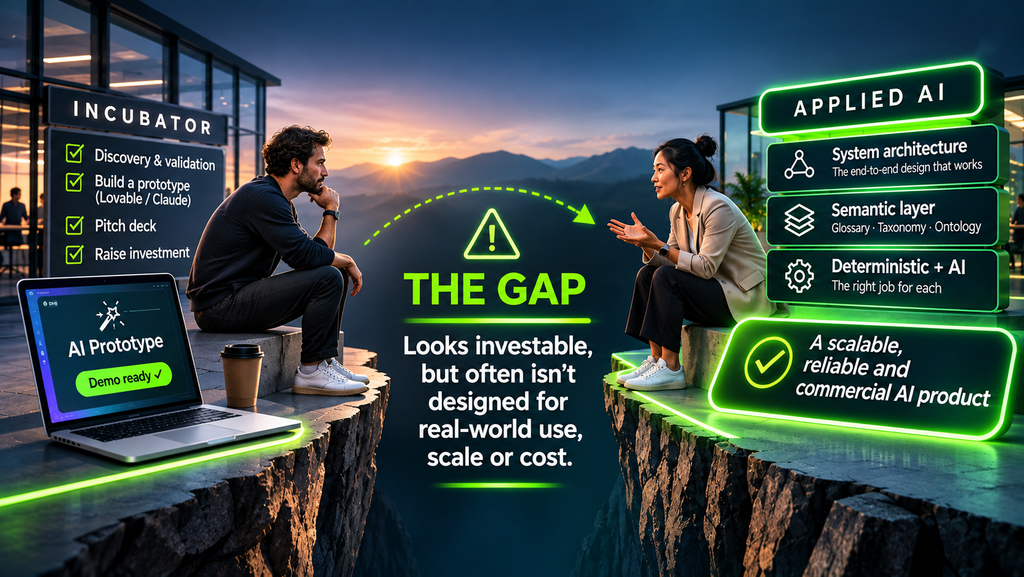
We’re getting very good at teaching founders how to validate an AI idea with a frontier model, but who’s teaching them how Applied AI gets implemented?
“I’ve learnt more in one hour than I have in three weeks inside the incubator.”
That was how a conversation with an AI startup founder ended this week.
She had nothing but praise for the people around her. The incubator was helping her understand the business problem, validate her idea and prepare to pitch investors. But she had hit a technical problem.
Her frontier large language model (LLM) was producing convincing answers that were fundamentally wrong. It lacked the business context needed to interpret the problem correctly, and she was being encouraged to rely more heavily on the model.
I asked whether she’d considered defining an ontology for the business.
“What’s that?”
And there, I think, is a serious problem with how some incubators are preparing founders for applied AI. If you are building an AI business, it is worth understanding the architecture beneath the demo — and where the real delivery risk sits — before you scale it.
We’re teaching founders to prototype, not necessarily to architect
Look at the typical startup journey: discovery, customer validation, MVP, pitch deck, investor readiness.
Increasingly, tools such as Lovable and Claude make it possible to build an impressive demonstration in days rather than months. That’s fantastic. But a working prototype is not the same as a working AI system.
- What happens when the application needs to understand specialist business terminology?
- When customer data has conflicting definitions?
- When an AI agent must follow established rules rather than invent its own interpretation?
Or when a cheaper model is introduced to reduce costs and the quality of decisions changes? Without systems architecture, founders risk building something that looks investable but becomes expensive to deliver.
And that means more engineering, repeated development, unreliable outputs and a business model whose margins deteriorate as customers arrive.
The missing discipline is the semantic layer
This is what worries me most.
A language model doesn’t inherently understand how your particular business operates. It doesn’t automatically know what constitutes an eligible customer, an approved transaction or a valid business decision.
That’s what the semantic layer helps establish.
It connects the language of the business with its data, definitions, relationships and rules, giving the system a consistent basis for interpreting information.
A business glossary defines terminology. A taxonomy organises concepts. An ontology can describe how entities relate to one another. Together with governed data, business rules and appropriate controls, these provide essential context for reliable AI applications.
This isn’t theoretical. Microsoft’s work on enterprise ontologies and dbt’s Semantic Layer demonstrate why consistent business meaning matters when AI starts interacting with real operational data. You don’t necessarily need a complex knowledge graph or expensive platform.
But you do need to understand what the model is being asked to reason about.
Otherwise, you’re asking probabilistic technology to compensate for architectural decisions nobody has made.
Three things we did in one hour
Rather than continuing to experiment with prompts, we went back to the business problem.
1. Designed the end-to-end system.
We mapped the problem, the information required, where deterministic processing belonged and where language-model reasoning could genuinely add value.
2. Defined the business glossary and taxonomy.
We established the terminology, concepts and relationships the application needed to understand. This gave us the beginnings of a semantic model rather than leaving the LLM to infer everything.
3. Built a prototype in Claude.
With the system design and business context established, we could build a much more purposeful prototype and identify what needed testing before production.
Three relatively straightforward activities. No enormous infrastructure investment.
But they changed the conversation from “Which AI model should I use?” to “How should this system actually work?”
That is applied AI.
Incubators need to teach what happens after the demo
To be fair, some programmes are already addressing this. Google’s Startups Immersion, for example, includes architectural reviews, practical AI engineering and unit economics.
But these disciplines should not be optional extras for founders building businesses around AI.
Before Demo Day, founders should be able to explain their system architecture, how business meaning is represented, where deterministic rules belong, how outputs are evaluated and what the application costs to operate.
They don’t all need to become software architects.
They do need enough architectural literacy to understand the business they’re asking investors to fund.
Just because a prototype can win investment, it does not mean it can turn into a reliable, economically viable product, investment simply finances the problems the incubator never prepared the founder to solve.
Are we preparing founders to build successful AI businesses, or simply preparing them to deliver convincing AI demonstrations?
Leave a comment below, and let us know what you think.
