The AI ROI Trap: Why companies spending millions on AI should start with creating the new strategic moat
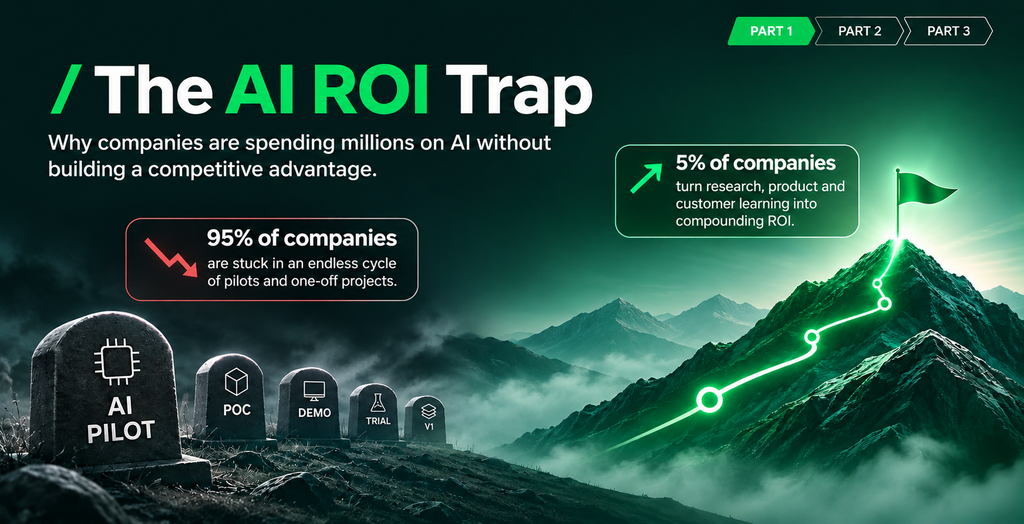
Five ways businesses using AI are putting their returns at risk, and what leaders should do before another investment disappears into a promising prototype.
There is a question we keep coming back to when we look at the number of companies building products around artificial intelligence.
What exactly does this business own that its competitors cannot buy tomorrow?
It sounds like a straightforward question, but the answer is becoming increasingly uncomfortable in the executive office.
A company may have an impressive AI product, excellent engineers, a sophisticated agent architecture and customers who genuinely appreciate what it has built. When those AI products improve, yesterday’s competitive advantage can quickly become a standard feature.
The answer is not to build everything from scratch. For most businesses, that would make little economic sense. The problem to solve is what companies build around those LLM models. Too many companies are producing impressive pilots without developing the applied research, reusable product capabilities or organisational knowledge that make each subsequent deployment more valuable. Every new customer risks becoming another expensive project, while the business struggles to demonstrate sustainable margins or measurable ROI.
This creates a dangerous paradox:
Companies could be financing the development of products whose competitive advantage becomes weaker as the underlying AI technology improves.
The businesses that succeed won’t simply be better at using AI, they’ll be better at turning what they learn into capabilities their competitors cannot easily replicate.
AI Project Stalled?
At Synaptix, we assess AI projects across strategy alignment, data readiness, systems integration, governance and risk, and financial risk, helping leaders understand what needs to change to deliver measurable outcomes.
The problem is not the LLM model. It is what the business is not building.
Most AI programmes focus heavily on selecting LLM models, designing architectures, and proving that the technology works. But the real commercial test begins when the demonstration ends and they hit production.
- Can the system reliably operate inside the customer’s workflow?
- Does it depend on data that the organisation can actually use?
- What happens when the model behaves unpredictably?
- How much will inference cost when usage increases?
- Does the same solution work in another business unit?
- Can a second customer adopt it without another substantial integration project?
For AI product companies, these questions determine profitability, differentiation and growth. For enterprises, they determine whether AI creates a lasting operational capability or simply another system to maintain. Yet many organisations continue investing without capturing what they learn, each deployment becomes another project rather than an opportunity to build reusable expertise.
This is where applied research becomes a commercial advantage. Not by building expensive AI laboratories, but by systematically testing technical limitations, developing differentiated capabilities and turning discoveries into products that can be reused and improved.
Without this discipline, companies risk becoming exceptionally good at delivering AI projects without becoming any better at building a profitable AI business.
There are five ways this happens.
Five problems quietly destroying the ROI of AI-native businesses
1. The company is renting its differentiation
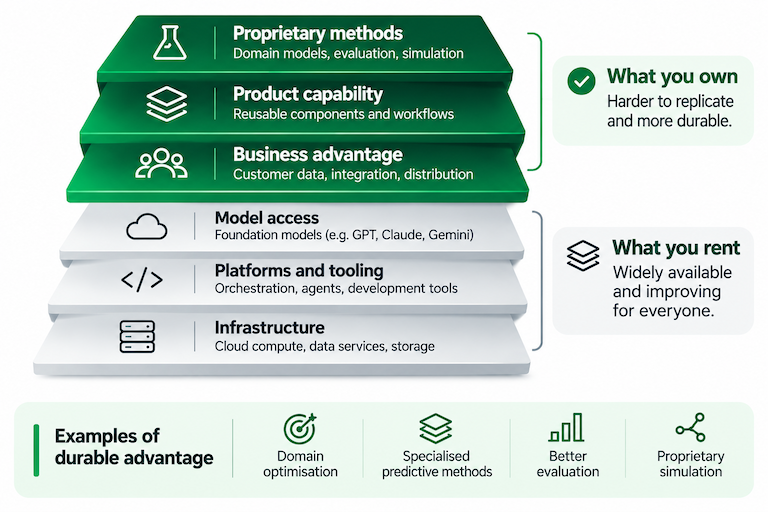
An impressive AI product does not necessarily mean a company has built a competitive advantage. If its performance depends primarily on foundation LLM models available to everyone, competitors can reproduce much of that capability. Even more concerning, a model provider could introduce the same functionality as a standard feature, eroding the value of what the business has spent months developing.
This does not mean companies should stop using external LLM models. The risk comes from confusing access to powerful technology with ownership of something differentiated.
Customer relationships, proprietary data, specialist workflows and distribution can provide defensible advantages. But applied research creates another opportunity. They develop domain-specific methods, evaluation techniques and reusable capabilities that competitors cannot simply purchase.
The commercial question is not how sophisticated the AI is, but how much of its advantage the business actually owns.
The quick win:
- Identify the three capabilities customers most value and compare them with what a competent competitor could reproduce using publicly available models and tools.
- For each capability, establish whether the advantage comes from the foundation model, proprietary data, unique research, accumulated customer evidence, workflow integration or distribution.
- Select one strategically important gap where differentiated research could produce a measurable advantage.
The objective is not to invent everything internally, it is to know what must be built and owned.
AI Project not going well?
If you are responsible for an AI project and cannot clearly explain its technical differentiation, production economics, reusable capability or expected financial return, it is worth assessing those weaknesses before committing more money.
2. Every customer requires another expensive project
The second problem appears when commercial success begins to create operational difficulty.
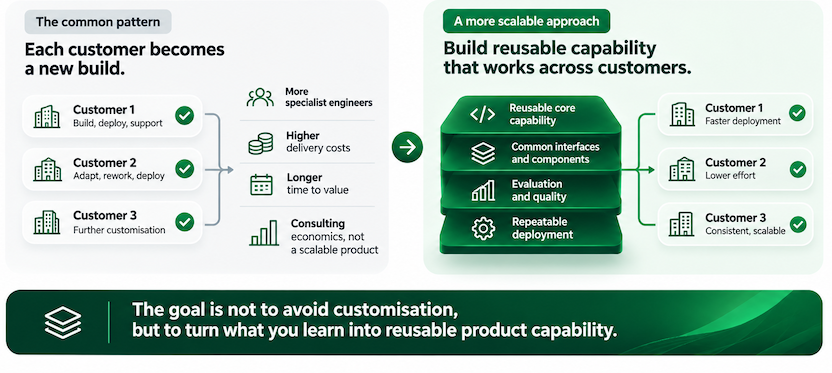
A company wins its first customer and builds a sophisticated solution. The customer is satisfied. The second customer arrives with different data, systems and requirements. The company adapts the technology and delivers another successful project. The third customer requires further customisation.
Revenue is growing, but delivery costs are growing with it. The company may be presenting itself as a scalable AI product business, but its operating economically like a consultancy.
Some customisation is inevitable in enterprise AI. The problem arises when every deployment requires rebuilding the underlying capability. Without common interfaces, reusable components and consistent evaluation methods, each new customer adds complexity rather than improving the economics of the business.
This is why research engineering and product architecture matter as much as scientific discovery. A differentiated algorithm or method needs common interfaces, reusable components, reliable evaluation and a deployment approach that works across customers.
Otherwise, each commercial engagement consumes the value created by the previous one.
The quick win:
- Compare your last three deployments.
- How much code, data preparation, integration, evaluation and support work had to be repeated?
- What percentage of the underlying capability was reusable?
- Identify the most expensive repeated activity and turn it into a shared product component before accepting another customer-specific implementation.
The question is whether the next deployment will become cheaper because the previous one happened.
3. The research and product investment is disconnected from customer value
The third problem exists in companies with the actual research teams as well as those without them.
A research team develops an impressive technical breakthrough. A product team delivers another set of features. Both report progress, yet neither can demonstrate whether the investment has made the business more competitive or profitable.
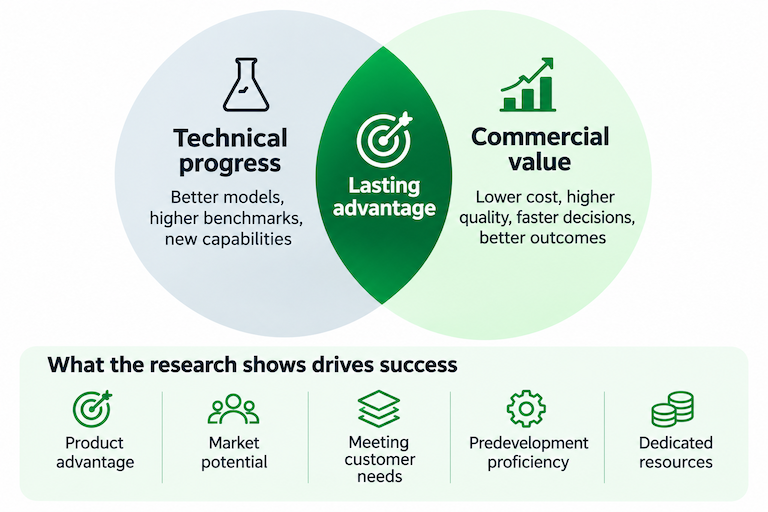
Scientific achievement is not the same as commercial advantage.
Strategy&’s long-running Global Innovation 1000 research found that companies using deep customer understanding to guide innovation were among the most consistently successful financially. Simply spending more on R&D did not reliably produce better financial performance.
Similarly, Henard and Szymanski examined 24 predictors of new-product success. Important factors included product advantage, market potential, meeting customer needs, predevelopment proficiency and dedicated resources.
The implication for AI-native businesses is significant. A model can outperform competitors in a technical benchmark yet deliver no measurable improvement in cost, quality, speed or customer outcomes.
The risk is funding research that makes the technology better without making the business better.
The quick win:
- For one strategically important AI project, write down the current customer problem, its measurable cost and the improvement the new technical capability must deliver.
- Establish a baseline and a credible alternative.
- Then ask the research and product teams to prove whether their proposed approach makes that specific outcome materially better.
If they cannot demonstrate the advantage, reconsider the investment before building more technology.
4. Nobody has calculated the economics of the product in production
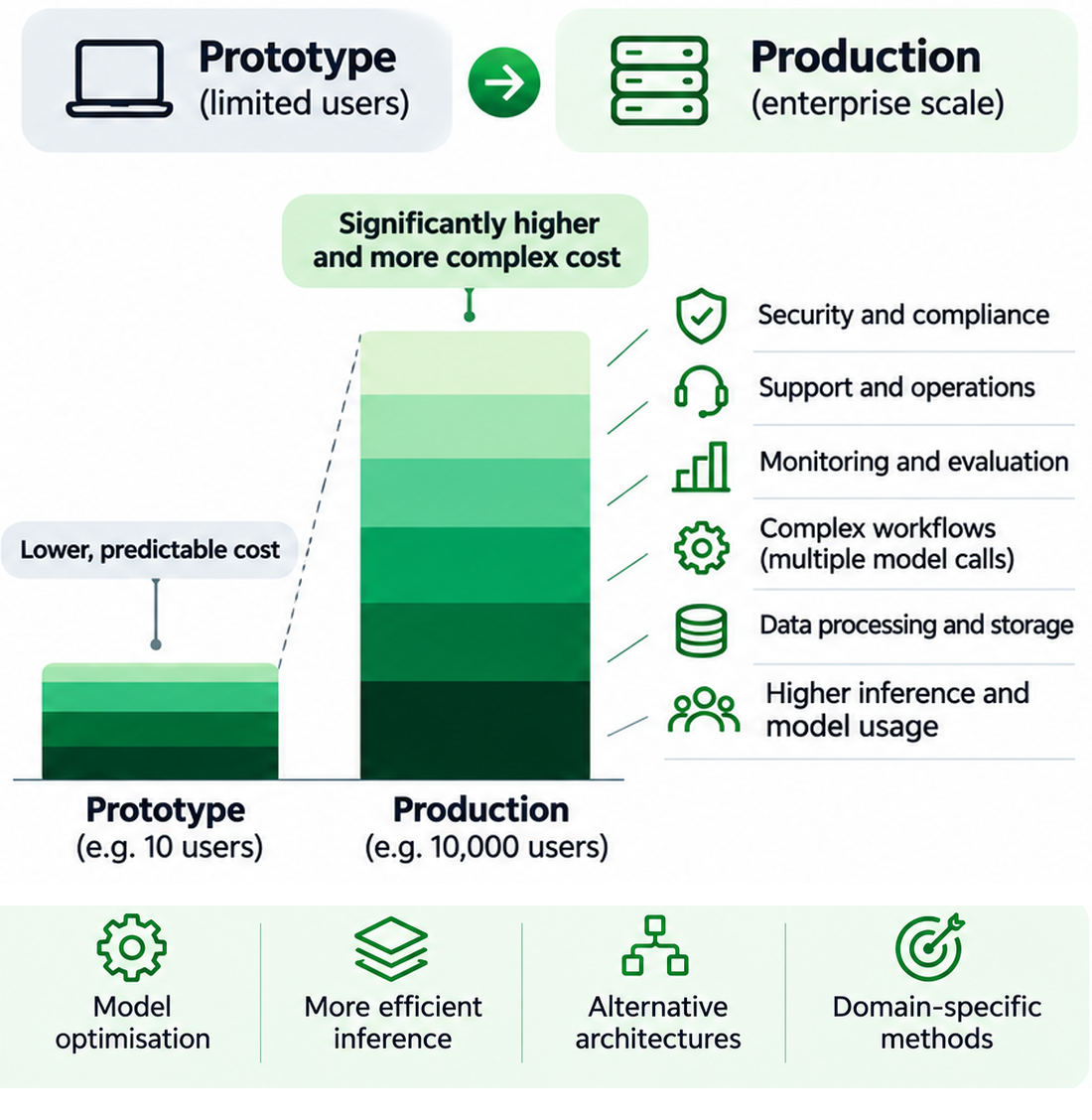
The fourth problem is particularly common in AI-native businesses because successful demonstrations can conceal the economics of operating at scale.
An AI prototype can demonstrate remarkable performance while concealing the true cost of running it in production. As adoption grows, so do inference costs, model calls, data processing and infrastructure requirements. Monitoring, security, evaluation and human oversight add further expense, while enterprise customers may demand bespoke integrations or data residency arrangements.
What looks profitable with ten users can become commercially unsustainable with ten thousand.
This is where applied research must go beyond improving model accuracy. More efficient inference, specialised models and alternative architectures can reduce the cost of delivering a reliable outcome without sacrificing performance. Yet many companies continue optimising for technical capability rather than the economics of operating at scale.
The real test of AI ROI is not whether the model accuracy or technical novelty works, but whether its value grows faster than the cost of delivering it.
The quick win:
- Model the whole-life economics of your highest-priority AI product at realistic production volumes.
- Include research, product engineering, deployment, inference, infrastructure, support, monitoring, governance and customer acquisition.
- Calculate the contribution margin per deployment and test what happens when usage increases.
- Then identify the most expensive technical constraint and determine whether a research-led improvement could make the product materially more economical.
A cheaper model response is useful. A consistently profitable customer outcome is much more useful.
5. The company keeps paying to learn the same lessons
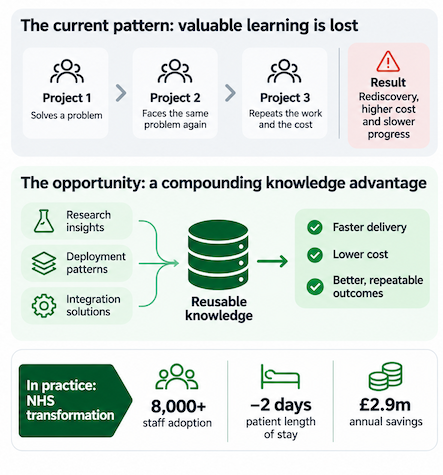
The fifth problem is less visible but potentially the most damaging over time.
An AI team solves a technical problem. Six months later, another team encounters the same issue and starts from scratch. Valuable research findings, failed experiments and successful integration methods remain buried in individual projects rather than becoming reusable organisational knowledge.
The company keeps paying to rediscover information it has already funded.
We have seen the consequences across enterprise AI, data and healthcare transformations. Organisations invest millions in sophisticated technology but often neglect the knowledge and operating practices needed to deliver consistent results.
In an NHS transformation I helped lead, success was measured not by the platform itself, but by adoption across more than 8,000 staff, a reduction in patient length of stay of approximately two days and recurring annual savings of £2.9 million.
For AI-native businesses, the opportunity is to turn every experiment and deployment into knowledge that strengthens the next product.
For an AI-native business, the equivalent opportunity is to make research and deployment knowledge reusable across its entire product portfolio.
The quick win:
- Create a common record of the experiments, decisions, failure modes, technical methods and deployment lessons from one completed AI project.
- Connect this evidence to the product components that were actually built.
- Before funding the next project, review what can be reused and which uncertainties have already been resolved.
The objective is not merely better documentation. It is to ensure the company does not repeatedly invest in solving the same problem.
The bigger risk is not falling behind in AI, it is falling behind economically.
LLM models are becoming more capable, infrastructure more accessible and sophisticated applications easier to build. That’s good news for most businesses, but it creates a serious threat for those whose products depend on technology their competitors can access just as easily.
What will customers continue paying you for when everyone has access to the same AI capabilities?
The answer isn’t necessarily a proprietary foundation model, it could be specialist research, unique data, integrated workflows or knowledge accumulated through successive deployments. What matters is whether those assets become more valuable, reusable and difficult to replicate as the business grows.
If every project starts from scratch, technical progress fails to improve customer outcomes and valuable learning disappears between deployments, the problem isn’t insufficient AI investment. The problem is that the investment isn’t compounding.
The problem is that the investment isn’t compounding.
The companies most exposed aren’t necessarily those using inferior AI, they’re the ones spending heavily without building anything they can repeatedly own, reuse and improve.
This is why applied research matters, not as another expensive department, but as a way to turn what a business learns into a competitive advantage that grows with every deployment.
Next in the series
In Part 2, We examine what good really looks like, using commercial evidence from Altair, Ansys, Dassault Systèmes, Databricks, and other research-driven companies. The focus is not their research budgets, but how they turn technical capability into revenue, customer expansion and commercial operating leverage.
We’ll examine what that looks like in practice, and what companies such as Altair, and Databricks can teach us about turning research into recurring commercial value.
For a deeper independent review of a live or stalled initiative, discuss your AI project with Synaptix.
