The AI ROI Divide: How companies that invest in AI research teams profit, while those betting on frontier models burn cash
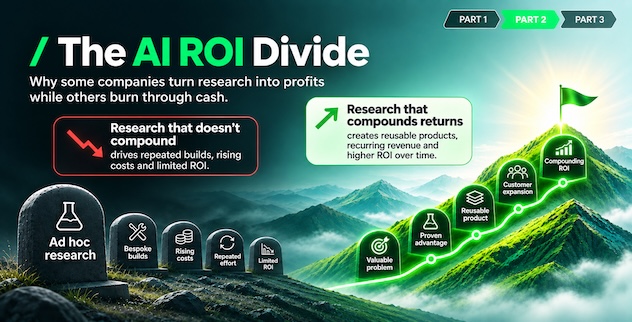
What we can learn from research-led teams turning AI scientific investment into recurring revenue, reusable AI systems and stronger commercial returns.
Ask a room of executives which LLM their business runs on, and most will answer straight away, Claude, ChatGPT, and Gemini. Ask the same room what it costs to serve one customer, and you’ll get silence.
That gap is why so little AI ROI is coming back. The LLM is the only part of an AI system most people can name, so it gets all the argument. Don’t get me wrong this does matter, pick the wrong LLM and the business finds out months later:
- Too expensive per call once everyone is using it.
- Not accurate enough for the decision it’s been handed.
- Running somewhere the data was never cleared to go.
By then it’s built into the IT budget and deployed with Enterprise licences, and changing it means doing the work again. We see this more and more and more and more, every month.
But the LLM is only 5% of the decision you make, what about the rest?
Imagine a company developing an impressive AI capability. The research team behind the AI idea turned it into an impressive solution, the commercialisation of the solution performs well, and the first enterprise customer is delighted.
Then a second customer arrives. Different data. Different systems. Different requirements. The research team is pulled back into development, engineers begin another integration, and much of the original work needs adapting. Revenue is growing, but so too are the costs of delivering it.
The company has successfully commercialised its AI research once, but has it built a business capable of generating a return on that investment repeatedly?
Everything that decides the answer to that question gets made again, with every customer who signs. This is where I see the AI ROI divide, and it’s what will make or break companies building AI solutions, beyond the LLM.
Some companies are already on the other side of it, because they didn’t get there by picking a better LLM. They started somewhere else entirely.
Let’s find out how this is actually being done.
AI Project Stalled?
At Synaptix, we assess AI projects across strategy alignment, data readiness, systems integration, governance and risk, and financial risk, helping leaders understand what needs to change to deliver measurable outcomes.
Using AI research to build, deploy, and sell repeatability
In Part 1, The AI ROI Trap, we examined five ways businesses lose value through repeated development, weak differentiation, disconnected research and poor production economics.
Now, some companies have spent decades solving these problems. In particular, Ansys, Altair Engineering and Dassault Systèmes have built substantial software businesses around specialist scientific research. Databricks demonstrates how research-originated technology can become an extensible commercial platform. Palantir and QuantumBlack illustrate different approaches to combining advanced technology with enterprise deployment.
Their results are not interchangeable, and they do not establish that simply employing AI scientific researchers produces superior ROI. They do, however, do something very different.
Before any of AI is built, they take the business apart.
Reverse engineer the business first, then re-engineer it so that AI operates inside business operations alongside human decision making, instead of bolting AI onto what was already there.
- how work actually gets done,
- which decisions matter,
- where the data comes from,
- what are the rules, if any,
- who is accountable when it goes wrong.
What they end up with is a depth in a domain that nobody can copy by signing up to the same LLM. Every customer they deliver to makes that depth sharper and the next delivery cheaper.
In a business built that way the LLM is a small part of the whole thing. In fact, it’s only 5% of the whole solution. The rest is the data, the integration, the governance, the operating model and the domain knowledge wrapped around it, and all of that is theirs.
That’s the new strategic moat.
Not the LLM, which anyone can rent by the hour. Everything the LLM has been fitted into. The companies still arguing about which frontier LLM is best will keep paying for tokens and subscriptions. Every release resets the argument, the bill goes up, the cost of delivery never comes down, and eventually they burn through the business looking for the answer in an LLM.
How are these companies achieving this?
They embed AI scientific research teams into their business as investment, and compound AI and domain knowledge, instead of spending on LLMs.
The greatest return on AI research may not come from the first product it creates, but from everything the business can subsequently build, deploy and sell because that research already exists.
There are five ways companies are doing this, and as a result, now generate new commercial value, net profits, from it.
Five things AI-native companies generating commercial value from research do differently
1. They start with an expensive customer problem, not an interesting technology
The first characteristic is deceptively simple, and research begins with a problem worth solving.
Not a fascinating algorithm looking for an application. Not a marginal improvement in a model benchmark. A commercially significant problem where existing technology is inadequate and solving it could produce measurable economic value.
Consider Ansys. Engineering businesses need to understand how products and complex physical systems behave before committing to expensive manufacturing, testing or operational decisions. Simulation allows engineers to explore these questions digitally, reducing dependence on physical prototypes and supporting better design decisions.
Ansys built a commercial software business around the mathematical and computational capabilities required to address those problems. In 2024, it generated approximately $2.545 billion in revenue, with $575.7 million in net income and a 28.2% GAAP operating margin.
Those are company-level results, not an isolated calculation of research ROI. Nevertheless, they demonstrate that specialised scientific capability can support a substantial, profitable software business.
The commercial proposition is not that Ansys has particularly sophisticated mathematics. It is that its software helps engineers address valuable technical problems more effectively.
This principle is reinforced by Strategy&’s long-running Global Innovation 1000 research. Its analyses found no reliable long-term correlation between the amount companies spent on R&D and their overall financial performance.
What mattered was how effectively organisations directed their innovation efforts, combined their capabilities and developed products that connected with customer needs.
The implication for businesses offering AI solutions is significant. A company should not invest in original research simply because a technical opportunity exists. It should establish whether the:
- Underlying problem is valuable enough,
- Existing technology is insufficient,
- Whether developing something differentiated could create an attractive commercial return.
What good looks like:
- Research investment begins with a measurable customer problem,
- An economic buyer and evidence that current approaches cannot deliver the required outcome adequately.
What to copy:
Before funding research, establish the cost of the problem, the value of improvement and the technical advantage required to justify the investment.
AI Project not going well?
At Synaptix, we assess AI projects across strategy alignment, data readiness, systems integration, governance and risk, and financial risk, helping leaders understand what needs to change to deliver measurable outcomes.
2. They prove an advantage customers will actually pay for
Scientific progress and commercial performance are different things.
An LLM can achieve higher accuracy, outperform established benchmarks or introduce an entirely new capability without improving the customer’s operating economics. The commercial test is whether that improvement produces something customers value sufficiently to pay for.
Schrödinger offers perspective on this. The company develops physics-based computational software used in pharmaceutical and scientific research, combining molecular simulation with machine learning and other computational approaches.
In FY2025, Schrödinger generated $199.5 million in software revenue, growing 10.6%, with a 74% software gross margin. That demonstrates the value customers place on specialist scientific capability, but the company also reported a $103.3 million net loss for the year.
This distinction matters, because strong software margins do not automatically translate into company-level profitability when substantial research and operating costs remain.
For a company investing heavily in AI, the equivalent risk is developing a technically superior solution whose additional performance does not justify the cost of creating, deploying and operating it. A more complex LLM might produce better predictions while making inference considerably more expensive.
A specialised architecture might improve accuracy while introducing significant integration and maintenance requirements. A research breakthrough might perform exceptionally well in one customer environment, but require extensive adaptation elsewhere.
This is why scientific evaluation needs to connect technical performance to commercial value.
Although heavily dated by over 20 years, research by Henard and Szymanski, examining 24 predictors of new-product success, identified product advantage, market potential, meeting customer needs, pre-development proficiency and dedicated resources among the most important factors.
Scientific novelty alone was not the determining factor, and the lesson is that research must create a product advantage that matters commercially. The same is true in today’s world of AI.
What good looks like:
- Every scientific improvement can be connected to a measurable customer outcome, with a credible financial benefit after accounting for the cost of delivering it.
What to copy:
Ensure research teams establish both a technical baseline and a commercial baseline. A better model is interesting, but a better business outcome is what justifies continued investment.
3. They work closely with customers without becoming bespoke consultancies
Customer proximity is essential in applied AI.
Enterprise customers expose researchers and engineers to operational constraints, specialist data, real workflows and the problems that determine whether technology creates value. But this creates a commercial tension. The closer a research organisation gets to individual customers, the easier it becomes to build solutions that cannot be reused elsewhere.
- A major customer requests a particular integration. The engineering team delivers it.
- Another customer needs a different configuration.
- A third requires substantial changes to the underlying workflow.
Before long, the company has strong customer relationships and growing revenue, but every new sale creates another expensive delivery obligation. The danger is that the research-led product business becomes a consultancy with proprietary software attached.
Research by Chang and Taylor, published in the Journal of Marketing in 2016, helps explain this tension. Their meta-analysis found that customer involvement during ideation and launch improved new-product financial performance, including through faster time to market. Heavy customer participation during development, however, was associated on average with slower delivery and weaker financial performance.
The lesson is not to keep customers away from researchers. It is to involve customers in ways that strengthen the common product rather than continuously reshape it around individual requirements.
Palantir demonstrates the commercial potential of combining reusable technology with intensive customer-facing engineering. In Q2 2026, Palantir reported approximately $1.935 billion in quarterly revenue, growing 93% year on year. Its US commercial business generated $764 million, growing 149%, while the company achieved a 47% GAAP operating margin.
These are substantial commercial results, although they do not isolate the contribution of research investment. QuantumBlack, McKinsey’s AI business, provides a related example.
McKinsey has described a portfolio of more than 20 AI products covering over 140 use cases, developed through collaboration between its R&D organisation and industry practitioners. Rather than developing entirely separate technical solutions for every engagement, the stated aim is to codify specialist knowledge into products and methods that can be deployed repeatedly.
QuantumBlack does not publish sufficient standalone financial information to calculate product-level profitability or research ROI, but its model demonstrates the importance of combining customer knowledge with reusable product development.
What good looks like:
- Customers help define valuable problems, validate performance and support early commercial adoption,
- The organisation protects the underlying methods and components required for reuse.
What to copy:
Establish paid design-partner engagements with measurable outcomes, clear intellectual-property arrangements and a deliberate distinction between customer-specific configuration and common product capability.
4. They turn scientific knowledge into software that works across customers
This is where the established scientific software industry becomes particularly revealing.
Ansys and Dassault Systèmes have spent decades translating complex mathematical, scientific and engineering methods into supported enterprise software. In 2024, Ansys generated approximately $2.545 billion in revenue, with a 28.2% GAAP operating margin. Dassault Systèmes reported approximately €6.24 billion in FY2025 revenue, with a 21.7% IFRS operating margin, serving approximately 390,000 customers.
Both companies demonstrate mature commercial systems built around specialist technical capability, but the important distinction is what customers are buying.
They are not repeatedly funding the original scientific discovery, they are buying access to products that incorporate proven mathematical methods, engineering expertise, tested software, enterprise integrations and accumulated technical knowledge.
Research remains valuable because it has been converted into something commercially repeatable.
This is precisely where many who are building AI into their businesses, struggle.
A good example of this is from Lanthaler, who explains why sophisticated AI predictions haven’t consistently translated into successful clinical outcomes or attractive financial returns. He discusses three issues:
- scientific capabilities that overpromise,
- the importance of reliable real-world data,
- the need for business models that actually capture value.
A successful LLM experiment is not necessarily a product, neither is an agent connected to a user interface. A reusable enterprise AI capability requires:
- common interfaces,
- deployment architecture,
- evaluation systems,
- monitoring,
- security,
- governance,
- operational support.
The underlying technology must also be maintainable as external models, data and customer requirements evolve. Without this foundation, every customer creates another implementation project. This is why research engineering and product architecture are as important as scientific discovery.
A differentiated algorithm may be valuable, but a differentiated algorithm that can be deployed across 100 customers without being reconstructed each time is potentially far more valuable.
What good looks like:
- Scientific capabilities can be deployed, maintained and improved across customers without requiring the original research team to rebuild the underlying technology.
What to copy:
Take one successful research-derived capability and establish what would be required to deploy it for ten customers. Prioritise reusable interfaces, evaluation methods, infrastructure and operational support before scaling sales.
5. They make every additional customer strengthen the return on research
The fifth characteristic is where the commercial economics become particularly interesting.
The strongest research-led businesses do not treat the first sale as the end of commercialisation, they develop a system in which existing customers, technical infrastructure and accumulated knowledge create opportunities for additional revenue.
Altair Engineering provides some of the clearest evidence of this approach. In 2024, before its acquisition by Siemens, Altair reported:
- $665.8 million in total revenue, including $611.9 million from software.
- Approximately $221 million invested in research and development.
- Approximately $140 million in free cash flow.
- More than 13,000 customers.
- An average 92% recurring software licence rate over the preceding five years.
- Historically, approximately 60% of new software revenue coming from expansion within existing customers.
The recurring licence rate describes the recurring nature of software billings, not customer retention. The important point is the relationship between research investment, software reuse and customer expansion.
Altair developed mathematical solvers, simulation methods and engineering capabilities that could be commercialised across multiple customer requirements.
- Customer-facing specialists understood operational problems.
- Research teams developed new capabilities.
- Product development incorporated those capabilities into a broader software portfolio.
- Company’s flexible licensing model allowed customers to access additional tools without purchasing each capability as an entirely separate product.
This created a commercial mechanism through which further scientific investment could generate value inside established customer relationships. The company did not necessarily need to acquire an entirely new customer every time its researchers developed another useful capability.
Databricks demonstrates a different version of the same principle. Originating from academic research into distributed computing, Databricks developed an enterprise platform spanning data engineering, analytics, AI and operational databases.
By August 2026, the company reported an annualised revenue run-rate exceeding $7 billion, growing more than 80% year on year. Its newer Lakebase product had exceeded a $100 million annualised revenue run-rate.
The platform allows successive capabilities to benefit from existing infrastructure, customer relationships and commercial distribution. Databricks’ growth does not establish an isolated research ROI, and its annualised run-rate is not equivalent to audited annual revenue or net profit.
Nevertheless, the model demonstrates how technical knowledge can support repeated commercial expansion. Altair and Databricks operate in different markets, but the commercial principle is similar.
Research becomes more valuable when the company can repeatedly monetise what it has already developed.
What good looks like:
- New research strengthens existing products,
- Creates additional commercial opportunities,
- Improves the economics of subsequent customer deployments.
What to copy:
Measure expansion revenue, technology reuse, deployment cost and contribution margin. The question is not simply whether research generates sales, but whether each investment creates further opportunities without proportionately increasing delivery costs.
The competitive advantage is what the business can do next
We are entering an era where increasingly sophisticated AI capabilities can be purchased and assembled with relatively little original research.
For many companies, this is an extraordinary opportunity, but for businesses competing on difficult applied-AI problems, the ability to develop differentiated scientific capabilities may become an important source of competitive advantage.
The challenge is commercialising those capabilities effectively. Research needs to solve valuable customer problems. Product development needs to turn scientific knowledge into reusable software. Customer deployments need to generate evidence that strengthens subsequent investment decisions, and the commercial model needs to ensure that revenue and value can grow without requiring the organisation to rebuild everything it has already developed.
The companies generating the strongest returns will not necessarily be those conducting the most research, they will be the ones that repeatedly earn more from what they have already learned.
That is when research begins to behave like a compounding asset rather than a recurring expense, and that is the real opportunity for businesses building AI solutions, not simply to develop better technology.
Next in the series
In Part 3, we examine five operating models for applied AI research, their commercial trade-offs and the hybrid model I believe offers many businesses building AI solutions a stronger route towards sustainable ROI.
We look at how research, research engineering, product development and customer delivery should work together, and how to measure whether the resulting organisation is generating an attractive return on its investment.
For a deeper independent review of a live or stalled initiative, discuss your AI project with Synaptix.
