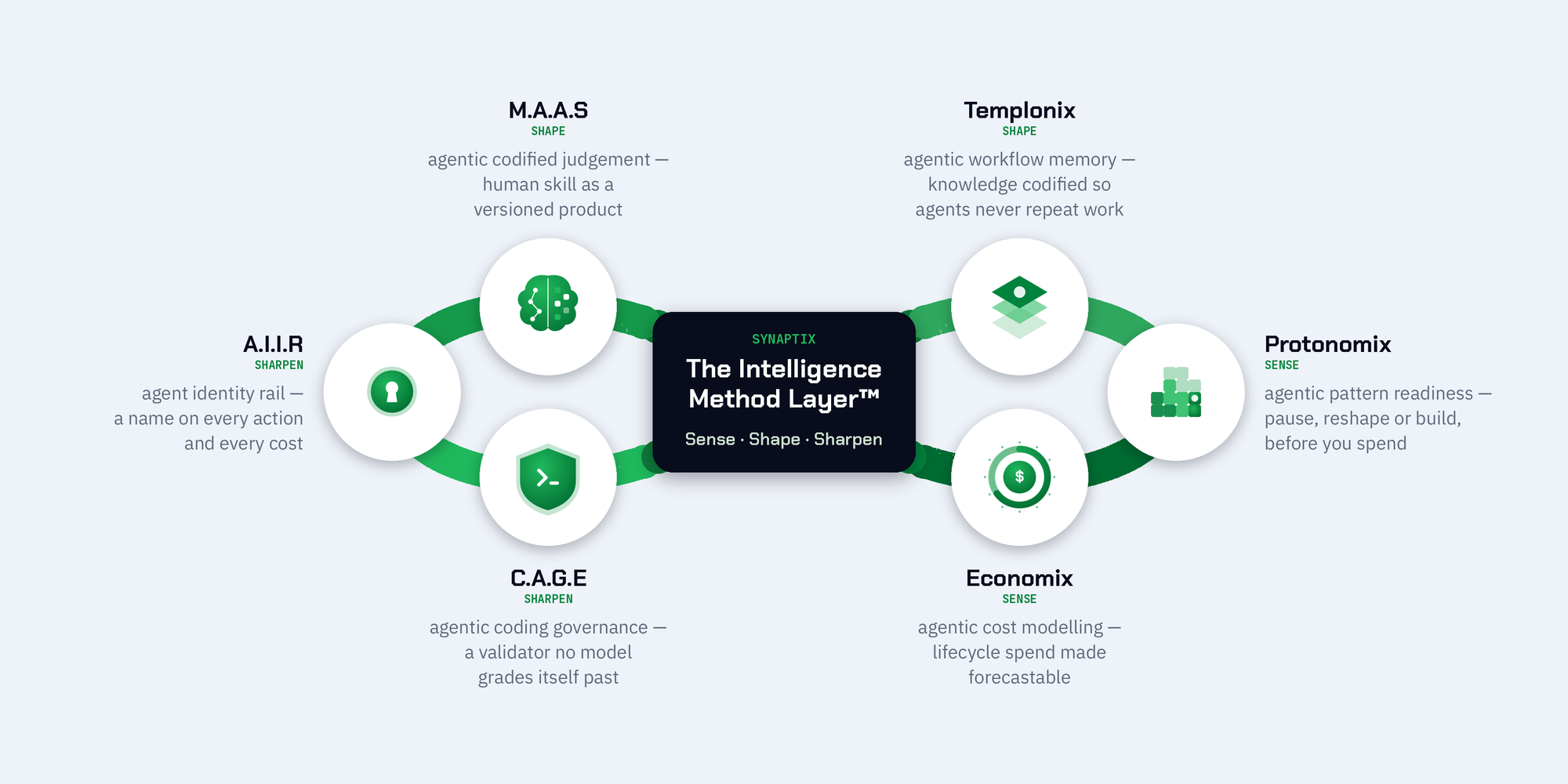
The Intelligence Method Layer™
Your AI investment should change your business economics.
You may already have AI projects, agents or working prototypes. The harder question is how these will grow revenue, improve margins or release operational capacity, and what needs to change in your business to achieve those results.
Your AI prototype works. What changes in your revenue?
A working AI system doesn't automatically produce a better business.
- A sales team might complete its research faster without winning more valuable contracts.
- A procurement team might produce BOQs more quickly without reducing the cost of a development.
- An executive might receive financial answers instantly without being able to make better investment decisions.
Then we establish what the new system needs to deliver to generate revenues.
Establish a measurable starting point. Model improvement against cost of AI delivery and operating system.
Not one optimistic financial number.
We model the range of outcomes, including higher demand, additional human review, integration and maintenance costs, and other operating conditions influencing the investment.
Revenue
New commercial opportunities, improved conversion, higher-value customer activity.
Net profit
Reduced operating cost and economically sustainable AI operations.
Operational capacity
Less time spent preparing, reconciling and repeating work.
Reusable intelligence
Expertise and decision knowledge retained as business assets.
47 years turning complex operational problems into working AI systems
Drawn from experiences of unsuccessful AI projects and more than 30 reviewed engagements in 2026.
NHS England
Moved hospital operations beyond counting beds by developing an AI patient-flow modelled on real-time demand, capacity, discharge, and length of stay, supporting better operational decisions.
Business Outcome: Create an AI system without another person checking it, to free up human resources for critical care.
Sensyne Health
Connected rare-disease clinical researchers with enterprise platform engineering teams, commercialising a clinical common data model before modelled with AI to create an intelligent synthetic-control-arm.
Business Outcome: Create a reusable business asset in a health-data platform scaling from 10,000 to 22.5 million patient records.
BP
Created a unified enterprise data platform, converting fragmented business domain information into governed, traceable data products to support engineering, finance and future AI Agent use.
Business Outcome: Cost against service demand, retries, and review efforts known when rising together and independently.
Sense. Shape. Sharpen.
A method supporting AI ambition from "is this even real?" to a governed agentic system finance will sign off and security audit will pass.
Find economic opportunity in AI
Identify the business decisions or operation worth improving, and model unpredictable and unbudgeted.
The analysis considers alternatives, whole-life costs, data availability and the conditions under which an investment produces business value and revenue.


Engineer the AI capability
Capture how people, decisions, workflows, and data need to change. Define the design of memory.
Assemble the expertise required to build the platform, decision system or AI-native operation, ensuring useful organisational knowledge becomes reusable.


Make the AI sustainable
Design the system governance, operational use, permissions, independent validation, financial monitoring and user feedback.
Measure the business improvement, strengthen the capability over time, and identify what agents have their own accounts to securely access data.


Find out which of your agents to build, reshape or pause.
A short, vendor-neutral read of one agent use-case — a verdict, a lifecycle cost envelope, and the decisions you haven't made explicit yet.